
Our Work
We provide design-build consulting services for marine dredging and port construction, including maintenance, excavation, and more. Our team of experienced professionals will give you the best shot at avoiding any surprises. Whatever scenario you’re looking at for your marine dredging project, chances are we’ve seen it before. Our broad range of expertise will help you to grow your business in a sustainable way.

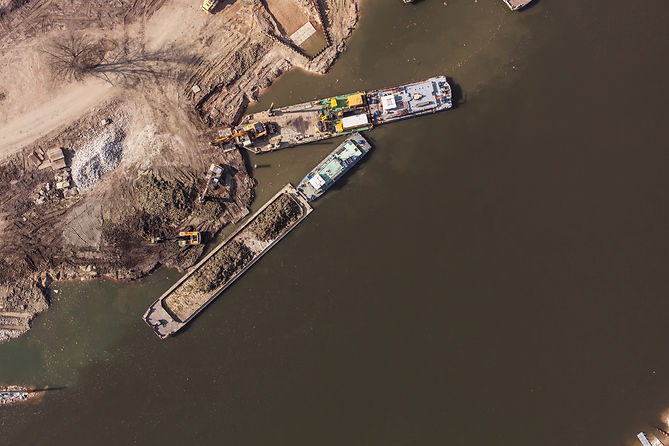
Backhoe dredger
Properties
Backhoe dredgers are water-based excavators that evolved from the land-based backhoe. The water-based backhoe dredger is a stationary, hydraulic crane mounted on a dedicated dredging pontoon that often has a rotating table.
How does it work?
The shell or bucket is moved toward the machine and when filled, emptied in barges. Like some onshore excavators, backhoe dredgers have a digging bucket attached to it which digs through a wide range of materials and when it is excavated it’s brought out and placed on the onboard barges.
Discharging
All BHDs regardless of size have a similar dredging cycle. The bucket is lowered into the water, the excavator bucket is filled by cutting and tilting and is then hoisted out of the water. The crane then swivels toward a nearby barge and the dredged materials are emptied into the barge. The BHD then swivels back and starts the process again.
Functions
Backhoes are mostly used for:
-
soil types like firm clay, soft rock, blasted rock,
-
when large stones can be expected, like the removal of waterside protections.

Сutter suction dredger
Properties
A cutter suction dredger is a self-propelled or stationary vessel that uses a rotating cutter head to loosen the material in the hard ground.
How does it work?
The cutter suction dredger is equipped with a cutting device known as a cutter head. The cutter head is a mechanical rotating tool, which is able to cut hard soil or rock into fragments. It is mounted in front of the suction head and rotates along the axis of the suction pipe. This rotation disaggregates, i.e., separates, and excavates the soil which is then drawn into the suction pipe as a solid/water slurry and pumped to the surface. Different cutter heads are designed for specific types of soil, because hard soil, non-cohesive or cohesive soils have different requirements.
Discharging
The material dredged by a cutter is usually transported hydraulically through a pipeline, although some cutters have barge-loading facilities as well.
The pumps produce the flow required to lift the disaggregated material from the bed and then to transport a water-soil slurry through a pipeline from the dredger to a discharge point. By use of booster pumps in the discharge lines, they can transport and place materials at considerable distances from the work site.
Functions
Cutter suction dredgers are used wherever the seabed is hard rock. They are used for larger dredging projects such as navigation channels and port development and maintenance and land reclamation.

Hopper barge
Properties
Barges are used to transport material that has been excavated by mechanical dredgers or to place other equipment at a dredging site.
How does it work?
Dredged material is loaded onto barges moored close to the dredger. The barges then transport the material to a designated area, where material is unloaded from the barges.
Discharging
The barges are being released through the bottom either through cable or hydraulically operated doors, or in the case of split-hulled barges by splitting the barge longitudinally. Sometimes the barges are unloaded using hydraulic pumps or mechanical equipment.
Functions
A hopper barge is a kind of non-mechanical ship or vessel that is designed to carry materials, like rocks, sand, soil and rubbish, for dumping to a designated area.

Tugboat
Tugs are used for moving non-propelled dredging equipment over long and short distances for a variety of purposes:
-
going to and from project sites,
-
to move hopper barges into position beside a dredger,
-
to push or tow hopper barges to the discharge location,
-
to assist large dredgers when they have to reposition or move to sheltered waters,
-
to transfer personnel on and off dredgers.